

Students Find Connection and Belonging with Indigenous Leadership 10
June 8, 2026
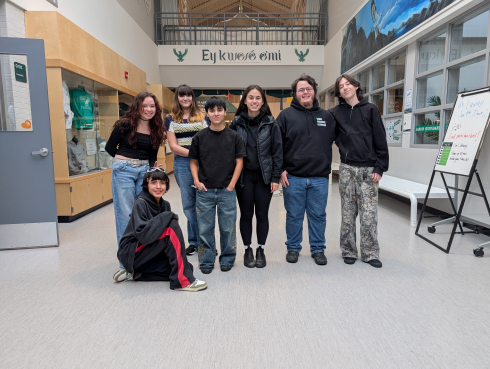
Students are finding connection, confidence, and belonging at Chilliwack schools with courses such as Indigenous Leadership 10.
Tobias Julian is an Indigenous graduate from Sardis Secondary who was instrumental in getting the Indigenous leadership course started at their school.
“I was having a hard time finding somewhere where I felt like I belonged. For a while I had to stop coming to school. I found it hard to find credits to take and I didn’t feel there were clubs for me,” said Tobias. “I looked into being part of mainstream leadership, but I figured that the way our people lead outside of school and work is a completely different kind of leadership.”
Tobias had an idea to start an Indigenous Leadership Club. After discussions with teachers and administrators and some research on other districts, the idea morphed. The school began offering an Indigenous Leadership credit course in January 2025.
“The leadership my cousin Autumn showed last year is one the most inspirational things I’ve witnessed,” said Grade 12 Sardis Secondary student Dwight Malloway. “Her achievements will be difficult to emulate, but I’ve never wanted to work this hard for something before.” Dwight is a student in the class.
Dwight is referring to Autumn’s personal project for the class. Personal projects explore an area of interest that serves community, revitalizes culture or cultural practices, and creates learning opportunities. These projects can be smaller-scale, like running a station at an Early Years Fair or a welcome lunch, or larger like a school-wide assembly. The main requirement is that the project is student-led.
While planning her project, Autumn thought about how to bring more Indigenous culture into her school. She wanted teachers and students to have a better understanding of Indigenous students’ cultural lives outside of school.
Last year, Autumn hosted an Honouring Ceremony at her school. It was a huge undertaking. She coordinated the event and successfully applied for a grant through Indigenous Youth Roots to fund it. She invited singers and drummers from Katzie First Nation to perform. She provided honorariums and bought blankets for honorees. She also arranged for Chief Darcy Paul from Skowkale First Nation (Sq'ewqéyl) to host the ceremony.
It was a way to create cultural understanding. It was also a way for Autumn to recognize staff for their contributions to Indigenous education and to the Chilliwack School District’s Indigenous Student Voice and Agency Group (ISVA). Autumn is a member of ISVA.
Honourees included folks like Sardis Secondary teacher Dale Servatius, who Autumn recognized for his decades of work in Indigenous Education. Servatius taught at Sardis Secondary for over 25 years, retiring in 2025.
“Mr. Servatius dedicated his whole career to educating people, and I don’t think he’s ever been to a ceremony. Since he couldn’t go to a ceremony, we thought we’d bring it to him,” she said.
Autumn’s project provided a glimpse into a traditional Honouring Ceremony, but it’s important to note that the event was for educational purposes only. There are parts that are for community members only.
On the same day as Autumn’s Honouring Ceremony, students Keira Point and Marcus Natrall hosted a Coastal Jam. A Coastal Jam is a cultural gathering with music, dancing, and community. Over 300 people attended – coming from as far as the Okanagan and the United States. Students from Chilliwack Secondary and G.W. Graham were also there. Coastal Jams are becoming more common and are often hosted at schools in the US. The students say this was the first time they have heard that a school in Chilliwack hosted a Coastal Jam of this size.
“Students want their experiences to be authentic and rooted in community,” said Katie Diaz. “By them taking the lead, they are able to do that.”
Diaz is an Alternate Education Teacher at Sardis Secondary. For two years, she has piloted the Indigenous leadership course. The course has a strong emphasis on personal and cultural identity. It’s rooted in cultural revitalization including language, traditional governance structures, and community engagement. There’s also an expectation of accountability to family, school, and community.
Lyrik Hall and Andrew Blakney’s personal project was also ambitious. Lyrik took the lead in organizing Sardis Secondary’s Truth and Reconciliation assembly in September 2025; Andrew returned to help with the event after graduation. They wanted to see the annual assembly reimagined with a focus on participation and language reclamation. They planned a Halq'eméylem lesson for the entire school.
Working with Elder Dr. Siyamiyateliyot Elizabeth Phillips and District Halq'eméylem Teacher Pedro Zullo, Lyrik and his classmate Julissa Joe stood in front of 1500 students and demonstrated a conversation in Halq'eméylem. They encouraged their peers to give it a try.
“It was nerve-wracking, but it was nice to see most students and teachers taking it seriously and trying to learn,” said Lyrik.
Students also planned a school-wide response alongside District Indigenous Enhancement Teacher, Valerie Tosoff. After the assembly, students and staff could write a Halq'eméylem word related to their learning on a feather. The class gathered all of the feathers and created large wings. They displayed the wings underneath the district’s vision statement: ‘Syó:ys lets’e th’ále, lets’emó:t’ or ‘One heart, one mind, working together for a common purpose’.
Students Aurelia Silver and Emma Goodyear also spoke at the assembly. They talked about what local First Nation communities are doing to revitalize language.
“Before this, I would have never volunteered to speak in front of the entire school,” said Aurelia. “With the support of this class, I was able to volunteer to speak at the Truth and Reconciliation assembly. It feels like I’ve grown into this classroom, and it feels like a second family to me. I’ve gained the confidence to speak.”
Diaz describes the language demonstration as a healthy risk. For some students, healthy risks can be joining class, leading a cultural activity, or lending their voices.
“One of the most impactful things that I’ve been able to witness since piloting this leadership course is to see how our students step up and collectively support each other. Together they encourage each other to take healthy risks.”
Tobias reflects on the experience of taking the class. “For me and for most people in the class, it’s the only reason we came to school or didn’t leave at lunch.”
Tobias and Diaz shared their learnings with a community of University of the Fraser Valley staff at an event called Indigenization – Moving Forward in a Good Way.
Students feel seen, welcome, and committed to their own learning. In the first year, 17 students completed Indigenous Leadership 10. For the 2025-26 school year, there are 30 students enrolled and a wait list. It’s a linear course, which means that students take it for the full school year. The increased connection to school is supported by class attendance data.
“There are a lot of great things happening here,” says Diaz. “And it’s cool because it comes from the kids.”